You have sourced high-quality coffee beans, invested in a precise scale, and dialed in your water temperature. Yet, when you take a sip, the flavor is either hollow and sour or intensely bitter and muddy.
What went wrong? More often than not, the culprit is the grind size.
Grinding coffee isn’t just about breaking beans into smaller pieces so they fit inside your brewer; it is a critical chemical variable that dictates how water extracts flavor. Understanding grind sizes is the ultimate cheat code to unlocking the hidden tasting notes of your coffee. Let’s break down the science of extraction, the primary grind sizes, and how to match them perfectly to your favorite brewing method.
Why Grind Size Matters: The Science of Extraction
When hot water meets ground coffee, it acts as a solvent, washing away soluble compounds – like organic acids, sugars, oils, and caffeine – into your mug. This process is called extraction, and it happens in a specific culinary order:
- Sour & Acidic: First, the bright fruit acids and sharp notes dissolve.
- Sweet & Complex: Next, the desirable sugars, caramels, and deep fruit notes are extracted.
- Bitter & Astringent: Finally, the heavy plant matter and bitter tannins dissolve at the very end.
Grind size controls the surface area exposed to water and how fast water can pass through the coffee bed.
- If your grind is too coarse: Water rushes through too quickly, and the surface area is too small. The water only manages to extract the initial acids, leaving you with an under-extracted, weak, and sour cup.
- If your grind is too fine: The particles pack together tightly, slowing water down to a crawl. The extended contact time strips everything from the bean, including the harsh back-end compounds, leaving you with an over-extracted, unpleasantly bitter, and hollow cup.
The Master Grind Chart: From Coarse to Fine
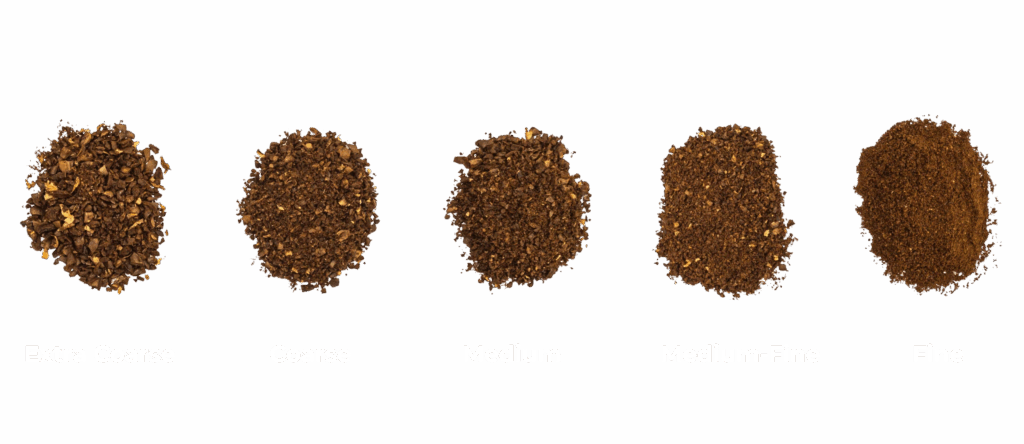
To keep your home brewing consistent, here is a guide to the standard grind sizes used across the coffee world.
1. Extra Coarse (Appearance: Peppercorns / Rock Salt)
- What it looks like: Chunky, distinct pieces of bean with minimal dust.
- Best for: Cold Brew. Cold brew relies on a long immersion time (12 to 24 hours). A massive grind size ensures the coffee doesn’t turn bitter or cloudy over that extended period.
2. Coarse (Appearance: Sea Salt)
- What it looks like: Rough, jagged granules, similar to coarse sea salt.
- Best for: French Press. French press filters use a metal mesh screen. A coarse grind prevents particles from slipping through the mesh into your mug, yielding a clean but heavy-bodied cup.
3. Medium (Appearance: Regular Sand)
- What it looks like: The perfect middle ground, reminiscent of dry beach sand.
- Best for: Flat-Bottom Drip Brewers & Clever Dripper. This size offers a balanced resistance for standard automatic coffee makers, allowing steady extraction over a 4-to-6 minute brew cycle.
4. Medium-Fine (Appearance: Table Salt)
- What it looks like: Finer than sand, but you can still feel individual grains between your fingers.
- Best for: Cone-Shaped Pour Overs (V60 / Chemex) & Inverted AeroPress. The conical shape requires a slightly finer grind to slow down the water as gravity pulls it straight through the center bed.
5. Fine (Appearance: Espresso Blend / Table Salt)
- What it looks like: Smooth and soft, but packs together slightly when pinched.
- Best for: Espresso & Moka Pot. Espresso machines use immense pressure to force water through coffee in just 25 to 30 seconds. The grind must be incredibly fine to create enough resistance against the machine’s pump to extract beautifully.
6. Extra Fine (Appearance: Powdered Sugar / Flour)
- What it looks like: A completely uniform, fine dust with no individual grains felt.
- Best for: Cezve (Traditional Turkish Coffee). Turkish coffee is completely unfiltered; the powder dissolves directly into boiling water, creating a thick, foam-capped, and deeply historic brew.
Blade vs. Burr: The Tools of the Trade
If you are looking to elevate your coffee routine, the tool you use to grind your beans matters just as much as the size itself.
- Blade Grinders: These use a spinning metal blade to chop beans haphazardly (like a blender). The result is a chaotic mix of massive chunks and fine dust in the same batch, leading to a cup that is simultaneously bitter and sour.
- Burr Grinders: These crush beans between two revolving abrasive surfaces (burrs). They offer incredible, micro-adjustable uniformity, ensuring every single coffee particle is the exact same size. If you want sweet, repeatable balance at home, a burr grinder is your single best investment.
The Golden Rule of Adjusting Your Grind
Think of this guide as your starting blueprint. Because every coffee bean has a unique density based on its origin and roast profile, you will always need to do a little fine-tuning.
Listen to your palate: if your morning brew tastes a little too sharp or thin, turn your grinder a couple of notches finer next time. If it leaves a dry, harsh bitterness on the back of your throat, back it up a few clicks coarser. By treating your grind size as a dial for flavor, you’ll transform a simple morning routine into a