

Most people assume cold brew and iced coffee are just two different names for coffee served over ice. In reality, they are completely different beverages created through two entirely distinct chemistry experiments.
While iced coffee relies on hot water to rapidly extract bright, aromatic acids before being chilled, cold brew trades heat for time – steeping coarse grounds in cold water for up to 24 hours to draw out natural sweetness while leaving harsh bitterness behind.
What is Iced Coffee?
Traditional iced coffee is simply hot-brewed coffee that has been cooled down and served over ice.
It is made using standard hot brewing equipment—such as a drip coffee maker, Pour-Over, or French Press. Because hot water (around 195°F–205°F / 90°C–96°C) quickly dissolves the bean’s soluble compounds, extraction takes only 3 to 5 minutes.
To prevent the melting ice from watering down the drink, iced coffee is often prepared using the Flash Brew (or Japanese Iced Coffee) method. This involves brewing hot coffee at double strength directly onto fresh ice cubes, chilling it instantly while locking in delicate aromatics.
What is Cold Brew?
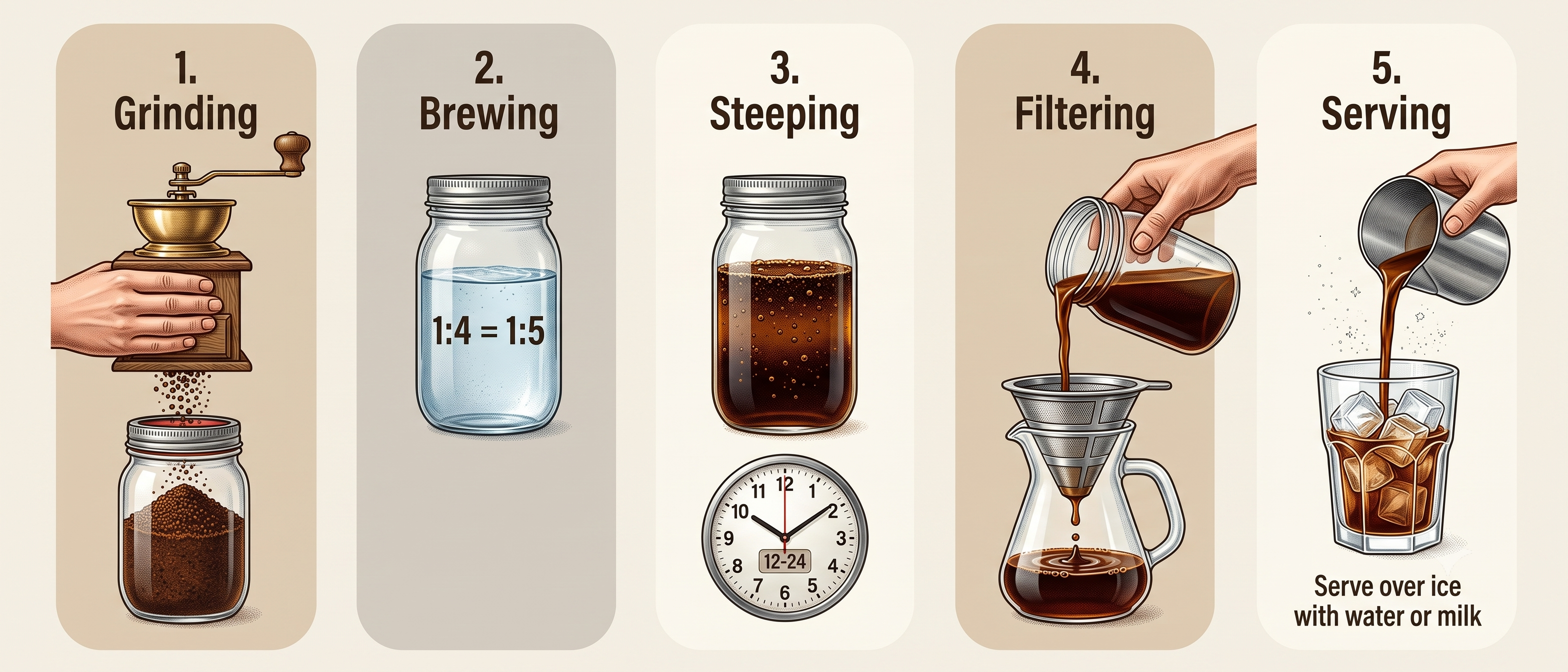
Cold brew is coffee made without using heat at any point in the extraction process.
Instead of hot water, coarsely ground coffee beans are submerged in room-temperature or cold water and left to steep for 12 to 24 hours. Because cold water extracts compounds much slower than hot water, time takes over as the primary brewing agent.
Once steeping is complete, the grounds are filtered out, leaving behind a rich cold brew concentrate. This concentrate is typically diluted with cold water, milk, or ice before drinking.
Do Cold Brew and Iced Coffee Taste Different?
Yes, they taste vastly different. Water temperature fundamentally dictates which chemical compounds, sugars, and organic acids are pulled out of the coffee bean, resulting in two distinct flavor profiles:
Cold Brew: Cold water fails to extract many of the intense organic acids and bitter solubles that heat unleashes. Consequently, cold brew is remarkably smooth, low in acidity, and heavy-bodied, showcasing deep notes of dark chocolate, roasted nuts, and caramel with virtually zero bitterness.
Iced Coffee: Hot water rapidly extracts volatile aromatic oils and bright organic acids. As a result, iced coffee tastes crisp, vibrant, and light-bodied, preserving the natural fruity or floral notes of the coffee bean. However, as hot coffee oxidizes while cooling, it can sometimes carry a subtle bitterness or astringency.
Whether you prefer the crisp vibrancy of a flash-brewed iced coffee or the velvety smoothness of a 16-hour cold brew, the secret lies in the quality of the bean. Because cold extraction highlights deep, rich flavors, starting with specialty, freshly roasted beans ensures your cup is nuanced, vibrant, and never flat.